ArticlesTraining
Can You Build Muscle With Bodyweight Exercises Alone?
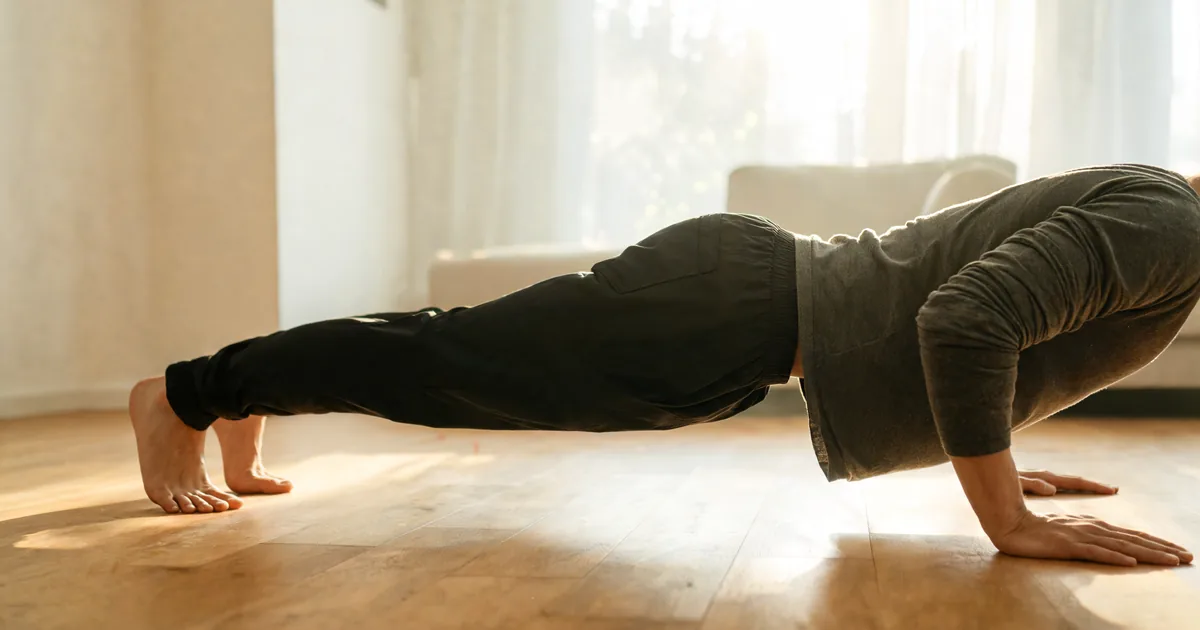
Short answer: strength definitely increases, but long-term evidence is lacking on whether it builds muscle as well as gym equipment. Because you cannot add weight plates, you need harder movement variations to create progressive overload. In a four-week trial, progressively harder push-ups increased bench press 1RM strength along with traditional bench pressing, and suspension push-ups produced high upper-body and core muscle activation.
How progressive overload works with bodyweight
Weight training increases demand by adding weight to the bar, but bodyweight exercise increases demand by changing leverage and contact points. You might progress from knee push-ups to regular push-ups, then to feet-elevated push-ups, or shifting more weight onto one arm. For muscles to grow, sets must be challenging, so instead of simply chasing endless repetitions, choose harder variations that bring you close to your limit within an effective rep range (What Is the Best Rep Range for Muscle Growth?).
What a 4-week push-up progression study showed
One trial followed 23 healthy, moderately trained young men (mean age 23 ± 6.8 years) split into two groups: 14 men performing progressive push-ups and 9 men performing traditional bench press, training 3 days per week for 4 weeks. After 4 weeks, bench press 1RM strength increased significantly in both groups. On a push-up progression test performing harder bodyweight variations, the push-up group achieved noticeably greater improvements. Muscle thickness, however, showed no significant change in either group over this brief 4-week span[1].
Even without adding barbell plates, progressively increasing movement difficulty can build upper-body maximal strength. Consistency across weekly volume remains the foundation of training (How Many Sets per Week Do You Need to Build Muscle?).
Muscle activation with suspension straps
Suspending hands or feet from straps adds instability to bodyweight movements. A review of 18 studies in physically active participants examined suspension push-ups, inverted rows, prone bridges, and hamstring curls. Muscle activation in the upper body and core ranged from moderate relative to maximum voluntary contraction (21–40% MVIC) to very high (greater than 60% MVIC). Except for the inverted row, suspension exercises produced higher upper-body and core muscle activation than comparable floor-based exercises[2].
Activation was high, but results varied greatly across studies, and whether muscle actually grew was not examined. When heavier external weights are unavailable, suspension straps offer a practical way to raise movement difficulty.
Strength changes compared to gym machines in older adults
A network meta-analysis evaluated 102 trials with 4,754 community-dwelling older adults (mean age 70 ± 4 years, range 63–87). Compared to an inactive control group, every resistance training method, including bodyweight exercise, produced meaningful strength gains. Machine-based training and free weights elicited the largest strength increases, yet bodyweight exercise still delivered clear and meaningful strength improvements[3].
Although bodyweight exercise ranked lowest among the five modalities, it clearly increased strength compared to the inactive control group.
Practical guidelines for bodyweight workouts
- Train 3 days per week. Mirror the frequency from the push-up study to maintain consistent upper-body stimuli[1].
- Advance the movement when it feels easy. Once you exceed target reps, elevate your feet to increase resistance.
- Introduce instability. To demand more from your upper body and core, incorporate suspension straps into push-ups or bridges[2].
- Work near your limit. Rather than accumulating light, effortless reps, select movement variations that feel genuinely demanding near the end of the set.
What these studies leave out
The push-up study was a small 4-week trial with 14 and 9 participants, and showed no change in muscle thickness (the duration may have been too short)[1]. The 18 suspension studies measured only electromyographic muscle activation during single sessions, without tracking muscle growth across months[2]. The 102-trial meta-analysis assessed maximal strength strictly in older adults with an average age of 70[3]. We cannot assume bodyweight training matches heavy gym equipment for long-term muscle size in experienced lifters. If you train without equipment, use progressive variations to maintain tension, while recognizing the practical ceiling of bodyweight loading over time.
How Muscle Today helps. Muscle Today focuses on the basics that matter most — your sets, recovery for 34 muscles, protein, and sleep — and every number links to its sources.
This article is general information for healthy adults and is not medical advice. If you have pain or an unusual condition, stop exercising and talk to a qualified professional.
References
- Kotarsky CJ et al. (2018) Effect of Progressive Calisthenic Push-up Training on Muscle Strength and Thickness. J Strength Cond Res PubMed
- Aguilera-Castells et al. (2020) Muscle activation in suspension training: a systematic review.. Sports Biomech PubMed
- Wiedenmann et al. (2025) The Effects of Different Resistance Training Modalities on Muscle Strength in Community-Dwelling Older Adults: A Network Meta-Analysis.. Gerontology PubMed