ArticlesTraining
Can You Build Muscle at Home with Only Dumbbells?
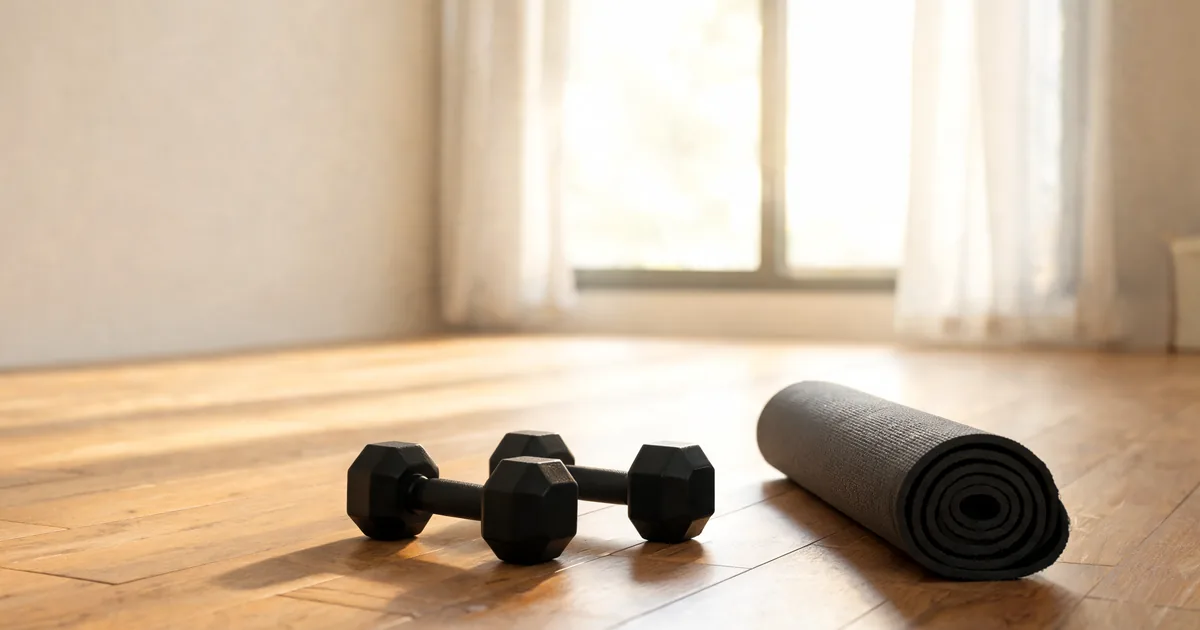
Short answer: In arm muscle studies, dumbbells produced similar muscle growth without expensive gym machines. A meta-analysis comparing free weights and machines also found little difference in muscle hypertrophy. In a small study of 10 people, curls at 40% of 1RM taken to failure still increased arm muscle volume.
What the Research Says: Dumbbells vs. Machines
Many lifters assume that training without gym machines reduces results. However, a meta-analysis comparing free weights and machine resistance exercise found little difference in muscle hypertrophy (though the wide confidence interval means they can't be called identical). There were also no significant differences in power changes. Strength gains depended on the testing equipment: when tested with free weights, free-weight training gained more strength, whereas when tested with machines, machine training gained more strength. When evaluated using neutral testing equipment, free weights and machines produced similar strength gains. [1]
Direct dumbbell training also demonstrates clear benefits in specific muscle groups. In a study of 23 young men (13 in the training group, 10 in the control group) performing triceps training 3 times per week for 6 weeks with dumbbells adjusted to 80% 1RM, long head triceps thickness and 1RM strength increased significantly. Meanwhile, the shear modulus of the muscle measured by ultrasound elastography showed no significant changes. [2]
Can You Build Muscle with Lighter Dumbbells?
A common hurdle with home workouts is working with limited dumbbell weights. Fortunately, lighter loads can still stimulate muscle growth if effort is sufficient. In a study with 10 healthy young adults, participants performed dumbbell curls at 40% 1RM until they could no longer lift the weight, 3 times weekly for 6 weeks. Low-load dumbbell training increased elbow flexor muscle volume significantly by approx 12% post-training (P < 0.01). This shows that lighter dumbbells can drive muscle volume increases when sets are taken to failure. [3]
In a 12-week trial that split 55 healthy postmenopausal women (58.2±5.6 years) into four groups, the two training groups (15 and 12 women) significantly increased skeletal muscle mass (training alone group Δ+1.2±1.3 kg, training + protein group Δ+1.4±0.9 kg; p < 0.05). Biceps muscle thickness also increased significantly in both training groups (Δ+0.3±0.3 cm and Δ+0.4±0.3 cm, respectively; p < 0.05). In contrast, a high-protein diet alone without exercise failed to alter body composition. Free-weight training also increased muscle mass in postmenopausal women (the program was not dumbbell-only). [4]
| Population | Protocol | Main Findings |
|---|---|---|
| 23 young men | 80% 1RM dumbbell triceps (3x/week, 6 weeks) | Triceps thickness & 1RM strength increased |
| 10 healthy young adults | 40% 1RM dumbbell curls to failure (3x/week, 6 weeks) | Elbow flexor volume increased by approx 12% |
| 55 postmenopausal women (15 and 12 in the two training groups) | Free weight training (3x/week, 12 weeks) | Skeletal muscle mass increased by 1.2–1.4 kg |
Practical Tips for Dumbbell Home Workouts
To maximize gains at home with dumbbells, consider these study-based practical adjustments. For rep recommendations, see our guide on What Is the Best Rep Range for Muscle Growth?
- Train close to failure with lighter dumbbells: As in the 40% 1RM protocol, when using lighter weights, push close to failure as outlined in Do You Need to Train to Failure to Build Muscle? to deliver sufficient stimulus.
- Maintain a consistent 3-day frequency: Follow the cited research protocols (6–12 weeks) by training regularly 3 days per week with adequate recovery between sessions.
Common Misconceptions About Dumbbell Training
A widespread assumption is that dumbbells are inherently inferior to gym machines for hypertrophy, or that free weights are universally superior. Meta-analytic evidence shows little difference in muscle growth between the two modalities. Another misconception is that home dumbbells are too light to sustain progress. However, evidence shows that lifting loads as low as 40% 1RM to failure increased muscle volume in a small 10-person study. The research suggests that what matters most may be the fatigue and stimulus delivered to the muscle, rather than the equipment itself. [1] [3]
Limitations of the Research
Several caveats should be kept in mind. The meta-analysis comparing free weights and machines did not focus solely on home training environments and relied on test-specific evaluation tools. The triceps study examined a single muscle group over a relatively brief 6-week timeframe. The low-load dumbbell trial had a small sample size of 10 individuals and only assessed elbow flexors. In addition, these studies did not examine building lower body muscle with dumbbells alone. Additionally, the female study involved a free-weight protocol that was not dumbbell-only, and was conducted specifically in postmenopausal women.
How Muscle Today helps. Muscle Today focuses on the basics that matter most — your sets, recovery for 34 muscles, protein, and sleep — and every number links to its sources.
This article provides general information for healthy adults and is not medical advice. If you have any medical conditions or symptoms, consult a qualified healthcare professional.
References
- Heidel et al. (2022) Machines and free weight exercises: a systematic review and meta-analysis comparing changes in muscle size, strength, and power.. J Sports Med Phys Fitness PubMed
- Akagi et al. (2016) A Six-Week Resistance Training Program Does Not Change Shear Modulus of the Triceps Brachii.. J Appl Biomech PubMed
- Farup et al. (2015) Blood flow restricted and traditional resistance training performed to fatigue produce equal muscle hypertrophy.. Scand J Med Sci Sports PubMed
- Ioannidou et al. (2024) Analysis of combinatory effects of free weight resistance training and a high-protein diet on body composition and strength capacity in postmenopausal women - A 12-week randomized controlled trial.. J Nutr Health Aging PubMed