ArticlesNutrition
How Much Protein Do You Need per Day to Build Muscle?
Short answer: about 1.6 grams of protein per kilogram of body weight per day (about 0.7 g per pound) covers most people who lift. Going up to about 2.2 g/kg (1 g per pound) is a reasonable upper target if you want a safety margin. Spread it over several meals. Your daily total matters more than exact timing.
Where the numbers come from
A meta-analysis of 49 trials with over 1,800 people found that extra protein helped resistance training add strength and lean mass — but the benefit for lean mass stopped increasing at around 1.6 g/kg per day[1]. Some researchers suggest using about 2.2 g/kg as an upper target to make sure nearly everyone is covered[2].
The International Society of Sports Nutrition lands in a similar place: 1.4 to 2.0 g/kg per day is enough for most people who exercise to build and keep muscle[3].
| Body weight | 1.6 g/kg per day | 2.2 g/kg per day |
|---|---|---|
| 60 kg (132 lb) | about 96 g | about 132 g |
| 70 kg (154 lb) | about 112 g | about 154 g |
| 80 kg (176 lb) | about 128 g | about 176 g |
| 90 kg (198 lb) | about 144 g | about 198 g |
When you need more: dieting
When you are eating less to lose fat, protein needs go up. For lean, resistance-trained people in a calorie deficit, a review suggested 2.3 to 3.1 g per kilogram of lean (fat-free) mass, with the higher end for leaner people and bigger deficits[4][3]. Note that this is per kilogram of lean mass, not total body weight.
How to split it across meals
A practical target is about 0.4 g/kg per meal over at least four meals, which adds up to 1.6 g/kg per day[2]. For a 70 kg person, that is roughly 28 g per meal.
You may have heard that your body can only "use" 20–30 g of protein at once. That is not quite right. In one short study of healthy young men, eating 100 g of protein after a workout produced a larger and longer muscle-building response — lasting over 12 hours — than eating 25 g[5] (it did not show whether muscle grew more over months). Bigger meals are not wasted; spreading protein out is simply an easy way to hit your total.
Does timing matter?
Much less than people think. A meta-analysis of protein timing found that once total daily protein was accounted for, eating protein right before or after training made no clear difference to strength or muscle growth[6]. If your daily total is right, you do not need to rush a shake after the gym.
Easy ways to get there
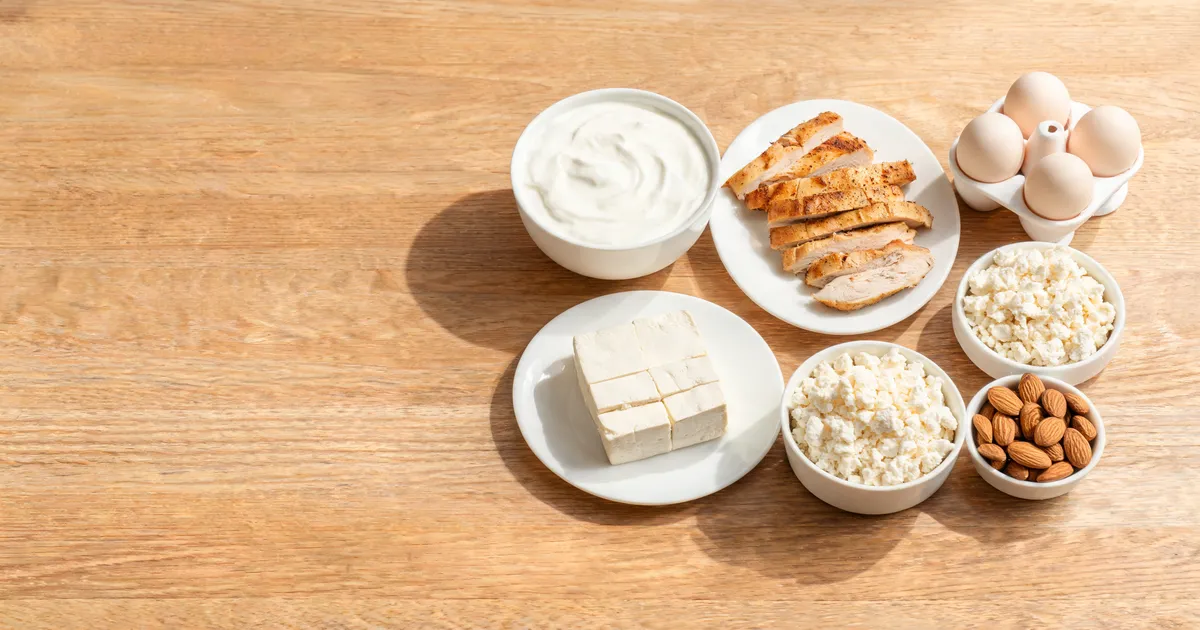
- Build each meal around a protein food: meat, fish, eggs, dairy, tofu, or legumes.
- Greek yogurt, milk, or cottage cheese make easy snacks.
- Protein powder is a convenient food, not a requirement.
How Muscle Today helps. Muscle Today tracks your daily protein against a target based on your body weight and goal, and you can import meals from other food apps through Health Connect. Every number links to its sources.
This article is general information for healthy adults and is not medical advice. If you have a medical condition or follow a special diet, check with a qualified professional before changing your protein intake.
References
- Morton RW et al. (2018) A systematic review, meta-analysis and meta-regression of the effect of protein supplementation on resistance training-induced gains in muscle mass and strength in healthy adults. Br J Sports Med PubMed
- Schoenfeld BJ et al. (2018) How much protein can the body use in a single meal for muscle-building? Implications for daily protein distribution. J Int Soc Sports Nutr PubMed
- Jäger R et al. (2017) International Society of Sports Nutrition Position Stand: protein and exercise. J Int Soc Sports Nutr PubMed
- Helms ER et al. (2014) A systematic review of dietary protein during caloric restriction in resistance trained lean athletes: a case for higher intakes. Int J Sport Nutr Exerc Metab PubMed
- Trommelen J et al. (2023) The anabolic response to protein ingestion during recovery from exercise has no upper limit in magnitude and duration in vivo in humans. Cell Rep Med PubMed
- Schoenfeld BJ et al. (2013) The effect of protein timing on muscle strength and hypertrophy: a meta-analysis. J Int Soc Sports Nutr PubMed