ArticlesRecovery
Should You Work Out When Your Muscles Are Sore?

Short answer: usually yes. Mild soreness is not a reason to skip the gym. Train a different muscle, or train the sore one lighter and a few reps further from failure. Soreness is not a sign that a workout "worked," and you do not need to chase it.
What soreness actually tells you
The stiff, achy feeling a day or two after training mostly reflects how new or how hard the workout was. It is strongest after exercises you are not used to or after a long break[1], and after a lot of slow lowering (the eccentric part of a lift)[2].
It fades quickly as you repeat the same training. Muscles adapt after the first exposure and react much less the next time[1]. In one ten-week study, signs of muscle damage were highest in week one and minimal by week ten[3].
Sore does not mean growing
It is tempting to treat soreness as proof of a good session. Research does not back that up. Programs that cause little muscle damage build about as much muscle as programs that cause a lot (soreness and muscle damage do not always go together), and the early, high-damage weeks are when the body is mostly repairing rather than building[4][3]. So if your usual workout no longer makes you sore, that is normal — not a sign it stopped working.
Why training a sore muscle feels worse
Soreness often comes with a temporary drop in strength. After heavy lowering work, strength stayed down for three to four days in one study[2]. That is why a sore muscle feels weak and why a hard session on it tends to go badly. The muscle is not "damaged beyond use," but it is not at full capacity either.
A simple way to decide
- Mildly sore, strength feels normal: train as planned.
- Clearly sore, warm-up weights feel heavy: train a different muscle today, or do the sore one with fewer sets and stop a few reps short of failure.
- Sharp pain, pain in a joint, or pain that gets worse during the set: that is not ordinary soreness. Stop and get it checked by a qualified professional.
Light movement is fine and may even help. For more on how long recovery usually takes, see how long muscles take to recover.
What helped with soreness in studies
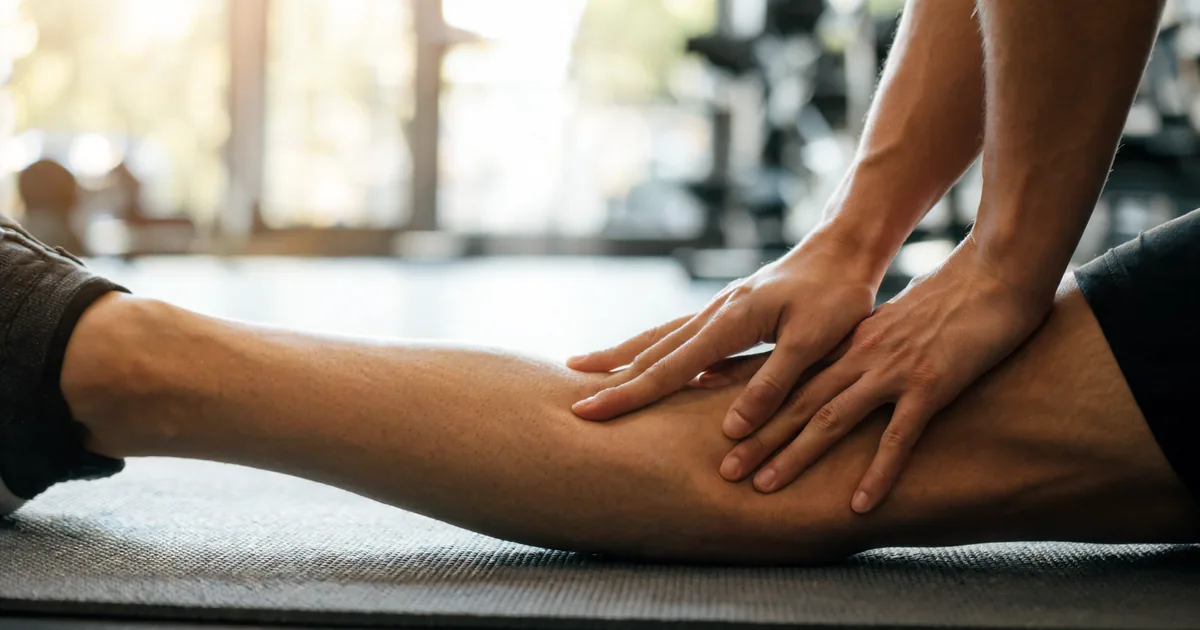
A large review of 99 studies compared common recovery methods. Active recovery (light exercise), massage, compression garments, water immersion, and cold were linked with less soreness afterward; massage had the strongest results[5]. In another review of massage alone, people reported less soreness at 24 to 72 hours and kept a little more strength[6].
Some popular ideas did not hold up as well:
- Stretching after training made almost no difference to next-day soreness — about one point on a 100-point scale[7].
- Protein around the workout helped people keep more of their strength in the days after, but made no clear difference in how sore they felt[8].
These studies looked at how people felt and how strength came back, not at muscle growth. They mostly change how you feel in the meantime.
How to get less sore in the first place
- Add new exercises gradually instead of doing many sets of something new on day one.
- After a break, start with fewer sets and build back up over a couple of weeks.
- Leave one or two reps in the tank on most sets. Going to failure adds fatigue[9] without adding much growth[10].
How Muscle Today helps. Muscle Today shows estimated fatigue for 34 muscles, so you can see at a glance which muscles are still recovering and pick something else for today. It also lets you log recovery activities like massage, and every number links to its sources. Estimates are roughly ±25% and do not apply to injuries.
This article is general information for healthy adults and is not medical advice. If you have pain or an injury, stop training that area and talk to a qualified professional.
References
- Hyldahl RD et al. (2017) Mechanisms and Mediators of the Skeletal Muscle Repeated Bout Effect. Exerc Sport Sci Rev PubMed
- Gibala MJ et al. (1995) Changes in human skeletal muscle ultrastructure and force production after acute resistance exercise. J Appl Physiol PubMed
- Damas F et al. (2016) Resistance training-induced changes in integrated myofibrillar protein synthesis are related to hypertrophy only after attenuation of muscle damage. J Physiol PubMed
- Damas F et al. (2018) The development of skeletal muscle hypertrophy through resistance training: the role of muscle damage and muscle protein synthesis. Eur J Appl Physiol PubMed
- Dupuy O et al. (2018) An Evidence-Based Approach for Choosing Post-exercise Recovery Techniques to Reduce Markers of Muscle Damage, Soreness, Fatigue, and Inflammation: A Systematic Review With Meta-Analysis. Front Physiol PubMed
- Guo J et al. (2017) Massage Alleviates Delayed Onset Muscle Soreness after Strenuous Exercise: A Systematic Review and Meta-Analysis. Front Physiol PubMed
- Herbert RD et al. (2011) Stretching to prevent or reduce muscle soreness after exercise. Cochrane Database Syst Rev PubMed
- Pearson AG et al. (2023) The impact of dietary protein supplementation on recovery from resistance exercise-induced muscle damage: A systematic review with meta-analysis. Eur J Clin Nutr PubMed
- Refalo MC et al. (2023) Influence of Resistance Training Proximity-to-Failure, Determined by Repetitions-in-Reserve, on Neuromuscular Fatigue in Resistance-Trained Males and Females. Sports Med Open PubMed
- Refalo MC et al. (2023) Influence of Resistance Training Proximity-to-Failure on Skeletal Muscle Hypertrophy: A Systematic Review with Meta-analysis. Sports Med PubMed